
Artificial intelligence (AI) is increasingly being used in various areas of public services to improve accessibility, efficiency, and quality. This use presents projections that will enable more effective outcomes for citizens and greater satisfaction with public services.
Some of the applications of artificial intelligence in public services include predictive analytics, healthcare, traffic management, public safety and emergency responses, social services, automation of administrative tasks, education, and chatbots and virtual assistants.
Among these application areas, chatbots and virtual assistants offer a range of content that can be considered alongside all other studies. Public institutions can use AI-powered chatbots and virtual assistants to assist citizens with routine tasks such as answering questions, providing information about services, filling out forms, or scheduling appointments. These AI-powered systems increase accessibility and reduce the workload on human resources by operating without time and location constraints. It is believed that, in addition to contributing to the efficiency of public service providers, significant contributions can be made to ensuring faster and more effective service for citizens.
Libraries, which aim to contribute to cultural and intellectual development by providing equal and free information services to all segments of society, inevitably need to utilize innovative technological tools to deliver their social benefits more effectively. Libraries, which have significant societal impacts such as literacy, information transfer, access to information, education and learning support, transmission of cultural heritage, and continuous learning, can improve their services and user experiences by using AI technologies.
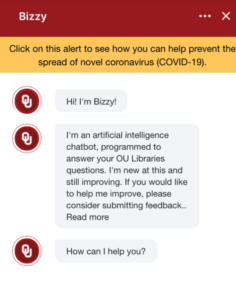
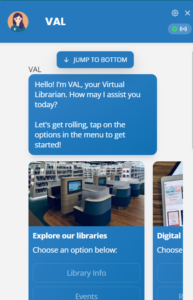
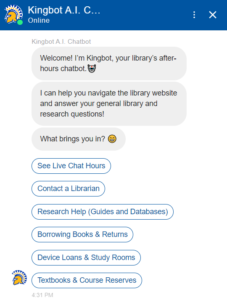
Libraries can utilize AI-powered chatbots for services such as reference assistance, renewal and reservation, catalog searching, orientation, and feedback. There are successful global examples of these services. For instance, the National Library of Singapore uses a chatbot called ‘VAL’ (Virtual Librarian) to provide information about its collection and answer questions about its services. The University of Oklahoma Library offers users a chatbot called ‘Bizzy’ that answers questions when the library and learning lab are closed or when staff are unavailable. Another chatbot application is the ‘Kingbot AI Chatbot’ (Dr. Martin Luther King Library) offered by Saint José State University Library. This application meets users' needs for searching, getting help with borrowing, and finding answers to service-related questions.
 |  |  |
In addition to various successful application examples currently used in information centers, it is possible to see that literature studies on the use of chatbots have also been increasing in recent years. This situation can be considered as an indicator of the growing trend towards chatbots.
The use of AI assistants continues to rapidly increase in all sectoral activities in Turkey and worldwide. In libraries, it is expected that the prevalence of virtual chat assistants will increase in the coming period, with the perspective of providing social benefits more effectively. These virtual assistants have the potential to optimize various services and provide a user-friendly experience, such as answering users' basic inquiry questions, ensuring accessibility at all hours of the day, assisting in searching the library's printed and electronic resources, providing information and reminders, and receiving service notifications from users.
The use of AI-powered applications in libraries, while offering potential for effectiveness, also raises a number of concerns. These concerns must be considered in terms of several parameters, including security risks, data privacy, protection of personal information, ethical and legal issues, and accurate access results. It is necessary to reflect these parameters in the services in a way that alleviates concerns, through measures and solutions that can increase user trust.
In this context, ensuring the responsible positioning and use of artificial intelligence technologies such as chatbots, while also addressing ethical and privacy concerns, is seen as one of the important service paradigms of the near future in information services. Creating technological infrastructures that take into account potential threats and concerns regarding usage is considered both inevitable and a tool that will add value to the societal benefits included in the mission of libraries.

 English